
If you've ever driven down a highway at night, visited a sprawling industrial lot, or walked around a large sports field after sunset, you've relied on high mast lighting to keep those spaces safe and usable. As a high masts supplier, one of the most common questions I get from clients-engineers, facility managers, and contractors alike-is "how do I calculate the right height for my high mast lights?" It's not a guess, and skimping on this detail can lead to dim, uneven lighting that fails to meet safety standards, or wasting money on a mast that's taller than it needs to be. After 12 years in this business, I've worked through dozens of these calculations with clients, and I'm breaking down the science behind it here, no jargon required.
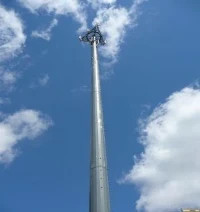
First, let's get clear on what a high mast light is, to set the stage. A high mast is a tall, vertical pole (usually steel, since it's durable and weather-resistant) that holds multiple light fixtures at the top, designed to illuminate large, open areas efficiently. Unlike small light poles that only cover a tiny spot, high masts can light 10,000 square feet or more from a single unit. The height of the mast is the foundation of that coverage, and getting it wrong makes every other lighting choice irrelevant.
So where do you start? The first step is defining your project's lighting requirements. Every space has different needs: a highway interchange needs uniform light for drivers to see road signs and obstacles, a parking lot needs to eliminate dark corners to deter crime, and a sports field needs specific light levels for players and spectators. Regulatory bodies (like the Illuminating Engineering Society, or IES, in the U.S.) publish guidelines for these levels, so that's your starting point. For example, IES recommends a minimum of 0.5 foot-candles (fc) for general parking lots, 2 fc for busy retail parking lots, and up to 50 fc for professional sports fields. That number will directly impact how high your mast needs to be.
Next, you need to map the area you're lighting. Let's say you have a 200x200 foot parking lot. You'll need to figure out how many high masts you'll use, and where to place them-usually spaced evenly, with no point more than half the distance between two masts from a light fixture. This "half-spacing rule" is key: it ensures light overlaps evenly, so there are no dim gaps. For a single high mast covering a 10,000 sq ft area (like a 100x100 foot spot), half the spacing between this mast and the next would be 50 feet. That number pairs directly with mast height, because the light's beam width and spread depend on how high it's mounted.
Here's the core calculation: for most general applications, the optimal mast height is roughly 1.5 times the width of the area the light is covering. Wait, let me make that concrete. If your light needs to cover a 50-foot radius (so a 100-foot diameter area), 50 x 1.5 = 75 feet. That's a typical height for parking lot high masts. But before you lock that in, you have to account for two big factors: light fixture beam angle and obstructions.
Beam angle is how wide the light spreads from the fixture. Some fixtures are narrow (15-30 degrees), designed for long-distance lighting like highways; others are wide (60-90 degrees), perfect for smaller, open areas like parking lots. If you use a narrow beam light on a short mast, you'll get a concentrated beam that only hits a small spot, leaving big dark areas. If you use a wide beam on a too-tall mast, the light will spread too thin, resulting in low foot-candles where you need them. That's why the 1.5x rule works as a baseline, but you have to adjust for beam angle. Let's test this: a wide beam fixture (80 degrees) mounted on a 75-foot mast will have a coverage radius of about 65 feet, which aligns perfectly with the 50-foot radius we needed earlier. If you used a narrow beam (20 degrees) on the same 75-foot mast, its coverage would only be about 27 feet-way too small for a 100-foot area. So always cross-reference your fixture's beam angle with height; most fixture manufacturers publish spread charts that show exactly how much area their light will cover at different heights.
Then there are obstructions. This is a step many people skip, and it causes big problems. If your high mast is going near power lines, buildings, or even existing trees, those things can block light and create shadows. That's where I've had clients reach out thinking their 60-foot mast is enough, only to find a 50-foot tall warehouse 30 feet away that blocks 40% of the light. When you have obstructions, you have to raise the mast enough to get the light over them. For example, if you have a 50-foot tall obstruction 20 feet from the mast, the mast height needs to be at least 50 feet, plus enough extra height to clear the obstruction by 10-15 feet to avoid shadowing on the area you're lighting. That brings us to 60-65 feet, instead of the original 50 feet someone might have guessed.
Another thing to consider is wind and structural stability. High masts, especially tall ones (100+ feet), have to stand up to strong winds, rain, snow, and even ice. The height of the mast impacts its structural load: the taller it is, the more force wind exerts on it. That's why we don't use the same types of poles for high masts that we use for small light poles. Many of our clients come to us knowing about lighting calculations, but not about structural design, and they ask if they can use poles from other applications-like those monopole power transmission line steel towers you can find at /wireless-towers/monopole-towers/monopole-power-transmission-line-steel-tower.html, for example. While those monopoles are engineered for vertical loads, they might not be optimized for the specific wind loads and light fixture loads that high masts carry. Our high masts are custom-designed to balance height, light coverage, and structural safety, so that the light stays in place even during a severe storm. I always advise clients to work with a supplier that integrates structural engineering into the lighting calculation process, not just the lighting itself.
Let's walk through a full example to make this real. Say you're designing a new 150x150 foot truck terminal, with the goal of meeting 1 fc light levels for general area lighting, per IES guidelines. Step 1: the area is 22,500 sq ft. We'll use 2 high masts, spaced 100 feet apart (so every point is within 50 feet of a mast, matching the half-spacing rule). Step 2: the required coverage per mast is a 75-foot radius (since half the distance between masts is 50 feet, we'll give a 25 foot overlap to be safe). Step 3: choose a wide-beam light fixture, 70 degrees, which has a recommended mounting height of 1.25 times the coverage radius. 1.25 x 75 feet = 93.75 feet, so we round to 95 feet. Step 4: check for obstructions. There's a 40-foot tall sign on the north side of the terminal, 30 feet from the first mast. We need to clear the sign by 15 feet, so add 15 feet to the height: 95 +15 = 110 feet. Step 5: confirm structural load. A 110-foot high mast holding 8 light fixtures is well within the design of our standard high mast models, which are tested to 120 mph winds and 20 pounds of ice. Done. That's a solid, science-backed calculation.
Common mistakes I see clients make: first, relying solely on the lowest height to save money, only to have to add more masts later, which ends up costing more. For example, if you put two 60-foot masts instead of 110-foot ones on that truck terminal, you'd need three more masts to get the same light level, which cancels out the initial savings. Second, not accounting for light spill-high masts can send light into adjacent areas, which might be a problem if you're near a residential neighborhood. That's why we sometimes suggest adjusting height or fixture angle to reduce spill, another factor that ties back to how you calculate height. Third, ignoring maintenance: taller masts are harder to climb for bulb changes, so if you want easier access, you might choose a slightly shorter mast with more fixtures, instead of a very tall one that's harder to maintain. That's a personal preference, but it's something to factor in.
As a supplier, I've seen clients bring us half-calculations, and when we walk through these steps with them, they're always surprised how much goes into it. The good news is that you don't have to be a lighting engineer to get it right. We have a team that works with every client to tailor the calculation to their exact space, requirements, and budget. We also source our materials from trusted manufacturers, including the monopole telecommunications towers at /wireless-towers/monopole-towers/monopole-telecommunications-tower.html, single tube landscape cell monopole towers at /wireless-towers/monopole-towers/single-tube-landscape-cell-monopole-tower.html, power transmission line steel towers at /wireless-towers/monopole-towers/power-transmission-line-steel-tower.html, and galvanized steel power towers for power transmission at /wireless-towers/monopole-towers/galvanized-steel-power-tower-for-power.html-though we adapt those designs specifically for high mast lighting, since our priority is balancing light coverage, structure, and cost.
If you're planning a high mast lighting project, the best first step is to reach out with your space dimensions, location, and lighting goals. We can help you run through the full calculation, check for obstructions, confirm structural needs, and even show you fixture options that fit your height. Whether you're lighting a small parking lot or a large industrial complex, getting the height right is the first and most important choice you'll make, and it's one that will pay off in safety, efficiency, and cost for years to come.


References
- Illuminating Engineering Society (IES). (2020). Lighting for Parking Facilities: ANSI/IES RP-20-20. New York, NY: Illuminating Engineering Society.
- American National Standards Institute (ANSI). (2018). Structural Design Criteria for Steel Poles and Towers. Washington, DC: American National Standards Institute.
- Lighting Europe. (2021). High Mast Lighting: Best Practices for Road and Area Lighting. Brussels, Belgium: Lighting Europe.