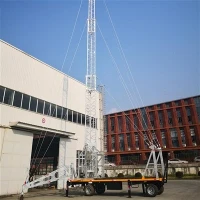

If you've ever relied on a mobile phone for a critical call, weather update, or emergency communication during a natural disaster-like a hurricane knocking out cell towers or a wildfire forcing a community to evacuate-you've probably wondered how that service suddenly comes back online when traditional infrastructure fails. That's where Cell On Wheels (COWs) come in. As a supplier that's specialized in portable, deployable wireless systems for over a decade, I've talked to emergency responders, network operators, and event planners who all share the same core concern when they first inquire about our equipment: how does Cell On Wheels ensure data security? After all, a COW isn't just a temporary tower-it's a moving hub for sensitive data, from public safety communications to user personal information, that needs to be protected whether it's set up in a hurricane zone at 2 a.m. or at a major concert in a crowded city.
When someone reaches out to us for a COW, whether it's our Emergency Solar Cell On Wheels Tower for off-grid disaster response or our standard models for temporary network support, security isn't an afterthought-it's the first component we design into every system. Let's break down how we build data security into every layer of our COWs, from the hardware that holds the network up to the software that manages the traffic flowing through it.
First, the physical security of the COW itself is non-negotiable, especially when these units are deployed in high-risk areas. Unlike fixed cell towers that are bolted to permanent foundations, our COWs are portable, but that doesn't mean they're easy to tamper with. All of our portable tower systems, from the Emergency Solar Cell On Wheels Tower to the Three-column Steel Pipe Communication Tower, are built with heavy-duty, corrosion-resistant steel that meets ASTM A36 standards (you can see that in detail on our Galvanized Self Supporting ASTM A36 Mobile Cell Tower page). The steel isn't just for withstanding wind-though our towers are engineered to survive Category 3 hurricanes-its thick gauge makes it extremely difficult to cut or breach without specialized equipment. That's a key point for emergency deployments: when we drop a COW in a neighborhood hit by a tornado, we need it to stay standing and stay secure from people who might try to access the network equipment to steal data or disrupt service.
But physical security goes beyond just the tower frame. Every COW has a lockable equipment shelter that's reinforced with steel doors and tamper alarms. These alarms don't just alert our team if someone tries to break in-they connect directly to a cloud-based monitoring system that we maintain for all our clients. So if a COW is deployed 50 miles from the nearest town, our clients (whether that's a public safety agency or a telecom company) will get a real-time alert on their phone or computer if someone tries to jimmy the lock or open the shelter after hours. We also add GPS trackers to every unit, so if a COW is moved without authorization, we can pinpoint its location immediately. For clients that need even more control, we offer customized security features for our Customized Cell On Wheels (COWs), like biometric access for the shelter or remote locking capabilities that let clients disable access to the unit's equipment from anywhere in the world.
Once the physical security of the COW is locked down, we turn to securing the data that travels through it. COWs are temporary base stations, which means they handle the same type of data traffic as fixed cell towers-texts, calls, emails, app data, even video streams from public safety body cameras. If that traffic isn't encrypted, it's vulnerable to interception, which is a huge risk for both regular users and emergency responders sharing sensitive information like evacuation routes or missing person reports. That's why every COW we sell comes with end-to-end encryption (E2EE) enabled by default. We use the same AES-256 encryption standard that fixed telecom operators rely on, which is considered unbreakable for practical purposes. Unlike some older portable network systems that only encrypt certain types of traffic, our E2EE works for every data packet that flows through the COW-from a kid sending a text to their parent during a blackout to a police department sharing real-time incident data.
But encryption alone isn't enough. We also build in secure authentication protocols to make sure only authorized devices can connect to the COW's network. When you use your phone to connect to a COW, it doesn't just join an open network-your device has to verify its identity with the COW's built-in authentication server. We use 5G-AKA (Authentication and Key Agreement) for 5G COWs, which is a standard developed by the 3GPP to prevent rogue devices from accessing the network. For 4G models, we use EAP-TLS (Extensible Authentication Protocol Transport Layer Security), which creates a unique, secure key for every device that connects. That means if someone tries to bring a fake device to a COW to steal data, it won't be able to authenticate, so it won't get access to any network traffic. We also let clients set custom access rules-for example, a concert promoter can restrict the COW's network only to ticketed attendees, or a public safety agency can limit connections to first responder devices only. That flexibility is one of the reasons clients come back to us for customized COWs for special events or emergency responses.
Another big part of data security for COWs is the monitoring and management system we provide. When a COW is deployed, our clients don't just get a box on wheels-they get a 24/7 dashboard that lets them track every aspect of the network, including data traffic, unauthorized access attempts, and potential security breaches. The dashboard sends alerts for any suspicious activity, like multiple failed authentication attempts from the same device or data transfers to unusual IP addresses. We also offer remote network management, so if there's a security vulnerability we become aware of (like a software patch that needs to be updated), we can push that update to the COW's software remotely-no need to send a technician to the site. That's especially critical for emergency deployments, where a technician might be stuck on a highway due to a storm and unable to reach the COW. We test all our updates rigorously, of course-we don't want to push a patch that could disrupt service during an evacuation, so every update goes through 5 rounds of security testing before it's deployed.
Wait, I should address a common concern I hear from clients: what if the COW is hacked? It's a fair question-portable systems are often seen as softer targets than fixed infrastructure because they're in temporary locations. But here's the thing: we design our COWs to be isolated from the main public network until they're fully secured. When a COW is first set up, it's in a "safe mode" where it only communicates with our client's dashboard and our monitoring system-no public traffic is allowed until security checks are complete. Once we verify that all the encryption keys are working, the physical shelter is secure, and the authentication system is active, we switch it to public mode. We also build in "kill switches" for every COW-if a client detects a breach or suspects the unit is compromised, they can immediately shut down all network traffic from the COW with one click on the dashboard. That's a feature that's saved our clients during at least two deployments I can remember: one where a group tried to access a COW set up at a music festival, and another where a fake device was detected trying to intercept emergency communications during a small-town wildfire.
Power security is another often-overlooked part of data security for COWs. Most people don't realize that if a COW's power source is compromised, that can put data at risk. For our solar-powered emergency COWs, we use deep-cycle batteries that are stored in the lockable steel shelter, and the solar panels are mounted on a reinforced telescopic frame (you can see that in action on our Cell On Wheels Telescopic Base Station page). The power system is isolated from the grid, so no one can tap into the COW's power line to access the network equipment. For clients that use grid-tied COWs for temporary events, we add battery backups that can keep the network running for 72 hours if the grid goes down, which means even during a power outage, the COW stays secure. We also encrypt all power-related data-like battery levels or solar panel output-so no one can intercept that information to figure out when the COW will be offline, which could make it a target for tampering.
I've worked in this industry for 12 years, and I've seen how a lack of security for COWs can have real-world consequences. A few years ago, we installed a COW for a disaster response agency after a flood in the Midwest. The agency told us that a competitor's COW deployed in the same area had a flaw in its encryption, and hackers were able to intercept communications between first responders, which almost led to a wrong turn that put a rescue team in danger. That's the moment I realized that data security for COWs isn't just a technical detail-it's a matter of public safety. So we didn't just add more encryption; we changed our entire design process. Now, every security feature we add is tested against real-world threats, not just industry standards. We work with third-party cybersecurity firms to audit our COWs every six months, so we can find and fix vulnerabilities before they're exploited. That's why our clients trust us for both emergency deployments and temporary network support for high-security events, like political conventions or professional sports championships.
Let's also talk about compliance, because that's a big part of data security for businesses and government agencies. Our COWs meet all the major global data privacy regulations, including GDPR, HIPAA, and FCC guidelines for public safety communications. That means if a healthcare provider uses our COW to transmit patient data during a disaster, they're in compliance with HIPAA. If a telecom company uses our COW in the EU, it meets GDPR requirements for data protection. We provide full security audit reports for every unit we sell, so our clients can show regulators that their temporary network is secure. That's a huge relief for our clients, because navigating compliance during an emergency or a big event is already stressful-they don't need to worry about whether their COW is up to code.


If you're reading this and you're in the market for a Cell On Wheels, whether it's for disaster response, a temporary event, or supplemental network support, data security should be at the top of your checklist. A COW that's fast to deploy is useless if it's vulnerable to hacks or data breaches. We've spent years refining our security features, from the physical steel frame to the cloud-based monitoring system, to make sure our COWs aren't just portable-they're secure. Whether you need an off-grid solar model for hurricane zones, a telescopic base station for a concert, or a fully customized COW for a unique deployment, we can build a system that meets your security needs.
If you're ready to talk about how our Cell On Wheels can support your needs, including data security tailored to your use case, don't hesitate to reach out. We're here to answer your questions, walk you through our security features, and help you find the right COW for your project.
References
- 3GPP TS 33.501: Security Architecture and Procedures for 5G System, 2021
- National Institute of Standards and Technology (NIST) Special Publication 800-131A: Revision 1, Transitions: Recommendation for Using Cryptographic Algorithms and Key Lengths, 2015
- Federal Communications Commission (FCC) Public Safety Wireless Network Security Guidelines, 2022
- International Telecommunication Union (ITU) Radiocommunication Sector (ITU-R) M.2150: Requirements for IMT-2020 Terrestrial Wireless Systems, 2019
- ASTM A36/A36M-19: Standard Specification for Carbon Structural Steel, 2019
- European Union General Data Protection Regulation (GDPR) Article 32: Security of Processing, 2016
- Health Insurance Portability and Accountability Act (HIPAA) Security Rule: 45 CFR Parts 160 and 164, 2003