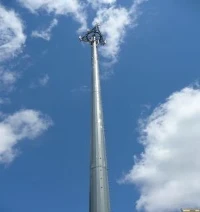

If you're here, you've probably spent enough time digging through telecom infrastructure specs to know that "monopole" isn't just a casual term-it's a foundational workhorse for wireless networks, 5G rollouts, and even small-town cell coverage. But if you've ever typed "Gay Monopole" into a search bar (and no, this isn't a typo), you've likely hit a jumble: one side is a niche of aesthetically pleasing, community-friendly telecom towers, the other is a confusing detour into particle physics. I'm a supplier of these towers, so I've fielded this question a hundred times, and it's time to clear up the real parity of a Gay Monopole.
First, let's kill the confusion: this isn't a reference to identity or sexuality. The "Gay" in Gay Monopole is a decades-old nickname, rooted in the core design of these towers. In telecom terms, a monopole is a single, slender vertical structure that radiates or receives wireless signals, unlike lattice towers which have cross-bracing for support. The "Gay" label comes from electrical engineering: monopoles have a parity that follows the properties of electromagnetic radiation, specifically the symmetry of the electromagnetic fields they emit. For a monopole antenna, the parity is odd-meaning the electromagnetic field flips sign (a 180-degree phase shift) when you invert the coordinate system, a defining trait of how vertical antennas operate. That's the scientific parity part, plain and simple.
But as a supplier, I know what most of you actually mean when you ask about a Gay Monopole: you want a tower that works, fits in your space, and doesn't alienate your local community. That's where the "beautified" part of the term comes in. Standard monopoles can look like stark, utilitarian poles that stick out of neighborhoods or rural landscapes like a sore thumb. A Gay Monopole is engineered to blend in, so it works for small towns, urban rooftops, historic districts, or even national parks where aesthetics matter as much as functionality.
Let's walk through the types we offer, because each has its own niche parity (and uses that fit different projects). First, the polygonal bionic pine tree cell tower. If you've ever driven past a highway that had a tower made to look like a pine tree instead of a metal pole, that's this one. Its parity? It's designed to mimic natural foliage, so it blends seamlessly into wooded areas or scenic byways. This isn't just a cosmetic trick-we build it with galvanized steel that resists weather, and the polygonal shape doesn't disrupt signal strength. It's perfect for state parks or tourist routes where the last thing you want is a structure that sticks out.
Next, the landscape steel monopole. This is our go-to for suburban areas where you need a tower that's sleek, understated, and fits into a residential streetscape. Unlike the bulky lattice towers of the past, the landscape steel monopole has a smooth, tapered profile that can be painted to match local building materials-think beige for brick neighborhoods, or dark green for tree-lined streets. Its parity here is about social fit: it meets local zoning rules that ban unsightly telecom structures, so you don't have to fight community pushback to get your network up and running.
If you're working with limited space, like a downtown office building or a small retail rooftop, the 15M Guyed Roof Top Beautified Telecom Tower is your answer. Guyed towers use cables to stabilize the structure, so they don't need a wide base on the roof-a huge plus for buildings with limited structural capacity. The 15-meter height is compact, and we can cover it in materials that match the building's facade, like terracotta panels for historic brick buildings or aluminum siding for modern glass structures. Its parity is compactness: it solves the "where do I put this?" problem for urban and small commercial sites that can't accommodate larger towers.
For larger projects, like power transmission lines or rural coverage for 5G, the top quality steel pipe power transmission antenna tower is our heavy hitter. These monopoles are built to support heavy antenna loads, multiple frequency bands, and long-range signal transmission. The steel pipe design is strong, durable, and requires minimal maintenance, making it ideal for highway corridors, farmlands, and remote areas. Its parity here is about capability: it's not just a pretty structure, it's engineered to handle the high demands of today's wireless networks.
And no matter which type you choose, we finish every monopole with a galvanized coating, which is non-negotiable for long-term performance. The galvanized communication tower steel pole is the backbone of all our offerings-this hot-dip galvanizing process coats the steel with zinc, preventing rust, corrosion, and damage from extreme weather like snow, wind, or rain. That means your tower will last 30+ years with minimal upkeep, a parity of reliability that's hard to find in other telecom infrastructure.
Now, let's circle back to the original question: the parity of a Gay Monopole. For engineers, it's the electromagnetic parity of the antenna, a well-documented property of vertical monopole radiators that sets them apart from other antenna types. For project managers and community leaders, it's the parity of purpose: a Gay Monopole is about balancing functionality with acceptability, making wireless access work for everyone, not just the bottom line. Too often, telecom infrastructure gets a bad rap for being eyesores that disrupt local communities, but these towers prove you can have both great signal and a structure that fits in.


If you're ready to explore which type works for your project, whether it's a small rooftop setup, a rural pine tree camouflage tower, or a heavy-duty power transmission structure, we're here to help. Our team has years of experience supplying Gay Monopoles to small towns, telecom companies, and government projects across the country, so we can guide you through specs, zoning rules, and installation timelines. We don't just sell towers-we partner with you to build infrastructure that works.
Reach out to our team to start a procurement conversation, and let's make sure your next telecom project checks all the boxes: signal strength, aesthetics, and long-term reliability.
References
- Balanis, C. A. (2005). Antenna Theory: Analysis and Design. Wiley.
- IEEE Standard Definitions of Terms for Antennas. (2013). IEEE Std 145-2013.
- National Telecommunications and Information Administration (NTIA). (2020). Community-Friendly Telecom Infrastructure Guidelines.