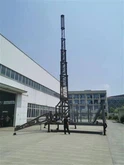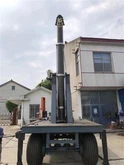


I. Truss tower flat elevation form
The most common structural form of a communication tower is a space truss tower. Most of its planar forms are regular triangles or regular quadrangles, see Figure 2-1.
角 Angle truss and steel pipe are commonly used in space truss members, so there are angle steel towers and steel pipe towers. The domestic angle steel is basically a right angle steel, and there are few angle steels with an internal angle of 60 °. Therefore, the angle steel tower basically adopts a regular quadrilateral cross section to facilitate the connection of the web. Steel tube components are much more flexible. Steel tube towers have regular triangular and regular quadrangular sections.
Since the minimum turning radius of the angle steel is very small, it is only about 1/5 of the side width. If a single angle steel member is used, the limit value of the slenderness ratio of the member must be considered. Therefore, the web beam form of the angle steel tower is often re-fractionated (Figure 2-1a) to reduce the free length of the member. The turning radius of a steel pipe is about 1/3 of its diameter, which is much larger than that of an angle steel. Therefore, the sections of a steel pipe tower can be pulled apart. It is appropriate to use a single inclined bar or a cross web system (Figure 2-1b, c).
The most commonly used structural form of communication tower truss tower members can also use round steel as the main limb or web. Its advantages are lower material prices and less wind resistance in the circular section. It is used as a prestressed flexible inclined bar in the cross web ( The use of flower basket bolts) is better, if used for the main limb, the material of large diameter round steel is poor and uneconomical.
II. Application of prestressed flexible web
Steel tower webs are divided into rigid oblique webs and prestressed flexible oblique webs. The latter has a smaller windward area and the length of the members is not limited by the slenderness ratio. Therefore, the prestressed flexible oblique webs use less steel. Rigid oblique bar is less.
作为 The tower is a cantilever structure. The bending moment and shear force of the tower body increase along the height of the tower body downward. The increase of the bending moment changes in a parabolic form, and the increase of the shear force has a linear relationship. Therefore, the internal force of the tower (mainly bearing the bending moment of the tower body) is a quadratic curve, and the internal force of the inclined bar (mainly bearing the shear force of the tower body) changes linearly.
最 The most common structural form of communication towers is that the lower column of the truss tower is subject to large forces, and the force of the inclined bar is relatively small. When the lower inclined bar is longer, it is more economical to use prestressed flexible inclined webs.
The flexible inclined rod is best to use prestress, on the one hand to avoid the flexible inclined rod to withdraw from the work once pressured, on the other hand, the non-prestressed flexible inclined rod has a slenderness ratio limitation, and the prestressed inclined rod has no slenderness limitation. In addition, the stiffness of the prestressed flexible inclined web tower is greater than that of the non-prestressed inclined web tower, so it is best to apply prestress if the flexible inclined web tower is used.