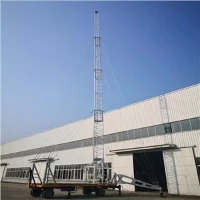


Communication towers, also known as cell towers or mobile masts, are tall structures used for transmitting and receiving wireless signals for various communication purposes such as mobile phones, TV and radio broadcasting, and wireless internet. These towers have become an essential part of modern communication, connecting people across great distances and enabling them to access information instantly. But how did these towering structures come into existence?
The concept of communication towers can be traced back to the early 19th century when optical telegraphs were used to transmit messages over long distances using a series of towers with semaphore arms. These towers were built on high ground or hilltops, and the semaphore arms were used to relay messages via a visual language using flags or lamps. This system was later replaced by the electrical telegraph in the mid-19th century, which used a series of wires strung above ground or underground to transmit messages across even greater distances.
In the early 20th century, the development of radio technology led to the need for taller structures to transmit radio signals over long distances. The first radio towers were simple, wooden structures built on hilltops or other high locations, and they were used primarily for military purposes. These early radio towers were limited in height and range, and they were often vulnerable to weather conditions and environmental factors.
As radio technology advanced, so did the need for taller and more robust communication towers. In the 1930s, the first steel radio towers were erected, reaching heights of up to 100 meters. These towers were designed to withstand strong winds and extreme weather conditions, and they were used mainly for military and government applications.
The development of television broadcasting in the 1950s and 1960s led to an even greater demand for tall communication towers. As television signals required higher frequencies and greater transmission power, taller towers were needed to transmit these signals over greater distances.
In the 1970s and 1980s, the growth of mobile phone technology led to the need for even taller communication towers. These towers, often reaching heights of over 300 meters, were used for transmitting mobile phone signals over greater distances and serving larger numbers of users.