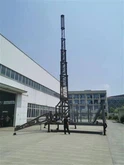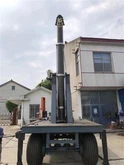


I wonder if you have ever seen a communication tower standing on a deserted mountain? So do you know how the communication transmission is built? How is the line drawn between the two mountains?
In the era of inconvenient transportation and underdeveloped equipment, it was all manual work to carry steel and cement to the mountain, then lay the ground, assemble steel frames (insulators, etc.), lay wires, and then use equipment to pull the wires to a certain level.
Now that the road conditions are slightly better, packs of parts are transported to the iron tower by animal power, and they are spliced and installed to form an iron frame.
Some people may ask, what should I do if there is no place where animal power can't go? If the animal power can't go up, you need to manually resist the equipment. If the above two conditions can not be achieved, it is necessary to transport by helicopter.
How is the line between the towers drawn?
An eight-rotor UAV is used. Firstly, a light and high-strength guide rope is laid through each base tower, and then the light guide rope is used to go from thick to thin to finally achieve the purpose of pulling the optical cable.
Prior to this, the traditional manual traction line had to be pulled out by manpower, which consumed a lot of physical strength and took a very long time. It often took a day for a line, and some construction sites were too dangerous to work normally with manpower, which would lead to project failure. can not complete. It is also said that there are great potential safety hazards, and it also consumes a lot of manpower and material resources.
The use of unmanned aerial vehicles to lay out wires across live lines not only improves economic benefits, but also has the characteristics of high safety performance, environmental protection and energy saving, strong adaptability, fast and accurate positioning, and low-voltage return. Compared with traditional manual setting-out, UAV can effectively overcome unfavorable factors such as complex landform and construction environment, and is especially suitable for complex areas such as high mountains, steep slopes, deep ditch mountains and river crossings, which greatly improves work efficiency and reduces Work intensity to ensure construction progress.
As technology becomes more and more developed, the construction process may become simpler and more efficient methods of operation will appear.