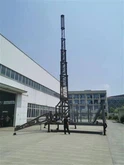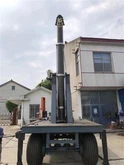


Cell site, also known as cellular set-up point, cellular base station, cordless telephone signal transmitter, cell site, cell site, cell tower (although many cell site antennas are not mounted on the tower) or A mobile phone mast (British English) is a site where antennas and electronic communications equipment are installed, and cellular telecommunications are set up, for cellular networks used by mobile phones. A signal station consists of an antenna tower (or an antenna built on an elevated facility, like a building), a radio transceiver, a digital signal processor, a control circuit, a GPS receiver for timing, a backup power supply, and a computer room. At this site, antennas and electronic communications equipment are placed, usually on a radio mast, tower, or other elevated location, to create a cell (or adjacent cells) in a cellular network. This elevated structure usually supports the antenna, as well as one or more transceivers, digital signal processors, control appliances, a GPS receiver for timing (for CDMA2000/IS-95 or GSM systems), main and backup power , and the cover.
The term "Base Station Site" may better reflect the increasing number of multi-operator consolidation sites, that is, multiple base stations, located on a single site. Depending on the technology used by the operator, even a site serving only a single operator may have multiple base stations, each serving a different air interface technology (eg, CDMA2000 or GSM).
Some cities require cell sites to appear unobtrusive, such as to blend in with their surroundings. Protected forest areas often hide cell towers on top of an artificial tree or a protected tree. These facilities are commonly referred to as "hidden cell sites" or "secret cell sites".
Cell sites are connected to the Base Station Controller (BSC) of the Mobile Telephone Switching Office (MTSO) via T1s (dedicated line or microwave) and T3s (dedicated line, microwave or fiber optic). The base station controller is connected to a telephone exchange connected to the public switched telephone network (PSTN).
The relationship between radio waves and cancer is still a hotly debated topic, and current safety regulations protect people from the dangers of overexposure to radio waves from cell sites.
The operating range of a cell site (the range within which a mobile device can reliably connect to the cell site) is not a fixed value. It depends on many factors, including but not limited to:
In general, in those locations where enough cell sites exist to cover a wide area, the range of each cell site will be set to:
In practice, cell sites are grouped together in densely populated areas with the greatest number of potential users. Cellular telephone traffic through a single site is limited by base station capacity. There is a finite amount of call or data traffic that a base station can handle at once. This limitation is a factor that affects the spatial distribution of cellular pole sites. In suburban areas, masts are usually placed 1-2 miles (2-3 km) apart, while in dense urban areas the masts may be as close as 1/4-1/2 mile (400-800 m) apart .
The maximum range of a mast (not limited by interference from other masts adjacent to it) depends on the same environment. Some technologies, such as GSM, typically have a fixed maximum range of 35 kilometers (22 miles), which is required due to technical limitations. There are no inherent limitations with CDMA and IDEN, but the limiting factor is the ability of a low-power personal cell phone to backhaul to the mast. A rough guideline is the ability to reach 50-70 kilometers (30-45 miles) based on a towering mast and flat ground. When the ground is hilly, the maximum distance varies from a minimum of 5 km (3.1 mi) to 8 km (5.0 mi) due to intervening objects intruding into the fresnel zone at the center of the signal's propagation. Depending on terrain and other environmental factors, a GSM tower can replace between 2 and 50 miles (80 kilometers) of cable for fixed wireless networks.
In a cellular network, however, the concept of "maximum" range is misleading. Cellular networks are designed to support a large number of sessions in a limited number of radio channels (the fraction of the radio spectrum required to conduct a session) that is licensed to an operator providing cellular service. To overcome this limitation, it is necessary to repeat and reuse the same channel in different locations. Just as when you travel to another city, a car radio switches from one local station to another completely different local station with the same frequency, the same radio channel is only used on a cellular mast a few miles away. reuse. To achieve this, the signal of a cellular mast is deliberately maintained at a low power, and in many cases sloping downward, in order to limit its coverage area. This allows it to cover an area small enough so that it doesn't have to support too many sessions than the available channels can carry. Due to the arrangement of the sub-sectors of the antennas on the transmitting tower, the intensity and angle of each sector can be changed according to the coverage of other towers within the line of sight of this sector.
A cellular phone may not work at times because it is too far from an antenna mast, or because it is in a location where the signal is weakened by a thick wall of a building, a mountain, or other structure. The signal does not necessarily have to have an unobstructed line of sight, but stronger radio interference can degrade or suppress radio reception. When many people try to use the cellular mast at the same time, such as in an event like a traffic jam or a sporting event, the signal will be seen on the phone display, but a new connection will be prevented. The other limiting factor of a cellular phone is the ability to send a signal to a cell site from its low battery. Some cellular phones will perform better than those with low power or low battery, usually because of the ability of the phone to send a better signal to the mast.
The base station controller (a central computer that handles phone connections) and only parts of the cell phone keep track of each other and allow the phone to switch from one mast to the next during a session. As a user moves towards a mast, it picks up the strongest signal and releases the signal from the mast that has weakened so that the channel from that mast is available to another user.
More information: Frequency reuse
Cellular geolocation is not as accurate as GPS, but can be used for those devices that do not have a GPS receiver, and where GPS is not available. The accuracy of this system varies and is highest where the Advanced Forward Link method can be used and lowest where only a single cell site is accessible. In this case, only The instructable geographic location is anywhere within the coverage area of the site.
An advanced forward link (Advanced Forward Link) means that a device is within the coverage of at least three cell sites, and the operator implements the use of the timing system.
Another method is to use the Angle of Arrival (AoA), which occurs when the device is within range of at least two cell sites, yielding a moderate degree of accuracy. Assisted GPS uses both satellite and cellular phone signals.
In the US, emergency calls use location data (locally known as "enhanced 911"), and it was required that at least 95% of cell phones support this service as of December 31, 2005. Many operators didn't meet this deadline and were fined by the FCC.
A functional agency of the U.S. government, the FCC, mentions this:
"For example, metrics obtained from various sources consistently indicate that the 'worst-case' ground-level power density near a typical cell tower is on the order of 1 mW/cm2 or less (usually the case is well below this value)."
Cell phones, cell towers, Wi-Fi, smart meters, DECT phones, cordless phones, baby monitors, and other wireless devices emit non-electrical radio frequencies, which are used by the World Health Organization (WHO). ) is only classified as "potential carcinogen".
Cindy Sage, co-editor of the Bioinitiative Report, wrote: "WHO's International Agency for Research on Cancer has just released its report on 'Non-ionizing radio frequency radiation is rated as 2B (probably) carcinogenic. ' decision. This classification is the same as DDT, lead, and engine emissions. This replicates the 2001 IARC finding that 'Extremely Low Frequency (ELF) was rated 2B (likely) carcinogenic'. This involves non-ionizing radiation at electrical frequencies (power lines and their equipment). These two findings confirm that non-ionizing radiation should be considered as a potential risk factor for cancer. In this case, new biologically based jobs are urgently needed. safety standard". Dr. Louis Slesin has been reporting on this issue for decades.
By controlling the electromagnetic wave emission energy of the base station, it can effectively use the electromagnetic wave resources and improve the use efficiency, so that the service range of each base station is limited to a certain range, and then a mobile communication network system is formed by a plurality of base stations. The areas are close to each other, just like honeycombs, so they are called cells or honeycombs.
The electromagnetic wave radiation intensity of the base station antenna decays rapidly with the increase of the distance, so as long as it maintains a proper distance from the base station antenna, there is no need to worry about the influence of electromagnetic wave radiation.
While cellular antennas are usually attached to fixed building structures, operators also maintain fleets of fleets, called Cells-On-Wheels (COWs), that serve temporary cell sites. It may contain a generator for use when the grid is unavailable, and the system may have a wireless backhaul link, allowing use when a wired link is not available.
COW is also used at permanent cell sites - to temporarily replace damaged equipment, during planned outages, and to boost capacity during, for example, conventions.
Cell site workers are known as Tower Climbers or transmission tower workers. Transmission tower workers often work at heights of up to 1,500 feet (460 meters), performing maintenance and repair work for cellular telephone and other wireless communication companies.
According to documents leaked by Die Spiegel, the NSA sold $40,000 of "active GSM base stations" that were used as a tool to disguise a cell phone tower and then spy on cell phones.
An off-grid cell site is not connected to the public power grid. Often such systems are not connected to the grid because of difficult connections or a lack of infrastructure.
Fuel cells or other backup power system systems are added to critical cell sites to provide emergency power. More sites use internal combustion engine-driven generator sets.
However, they increase operating costs (OPEX) due to being less efficient than the public grid, and are a source of pollution (atmosphere and noise, etc.), and some are protected by the environment and landscape.
Renewable energy sources such as solar and wind energy may be available at the site of the cell site. They can be backed up by a fuel-generator system, allowing cell sites to still operate if renewable resources are scarce.
Energy from intermittent sources is stored in secondary batteries, which are typically designed to have an average of 5 days of self-sufficiency, allowing maintenance crews to have enough events to arrive when repairs are needed.
Renewable energy systems provide electricity when available. Fuel cells are only activated when natural resources are not sufficient to provide the energy required by the system. The emergency power source (fuel cell) is designed to last an average of 10 days. In this way, the system is completely self-sufficient: this allows the maintenance team to only have to reach the site in small quantities, since those places are usually hard to reach.
Mobile communication base stations are often regarded as disgusting facilities, and the installation of each site often faces opposition from local residents due to safety and appearance. The latter is sometimes solved by disguising the mast as something else, such as a flagpole, a street lamp, or a tree, or a roof installation, or an urban installation, such as a chimney, trim panels.
These covert cell sites can camouflage themselves by camouflaging themselves in the shape of plants or the color of bark. The camouflage for all of these antennas consists of plastic leaves, which are precisely designed in consideration of the number, shape, and shape to fit the array to completely hide the antenna and all appendages in their natural form. The materials used guarantee absolute radio transparency and are resistant to UV rays. Nicknames include "monopalm" because a monopole is disguised as a palm tree; or "false pine phone" because a mast is disguised as a pine tree. In monopole antennas, the directional antenna is sometimes hidden in a plastic cover at the top of the pole so that the bar can be removed.
Roof structures, such as hidden chimneys or trim panels, are approximately 6 to 12 meters high and can conceal one or more mobile phone operators at a site. Roof coverings can be fastened to existing roof structures to change styles quickly and inexpensively.
Mobile phone base stations are becoming a symbol of an era, connecting and interweaving both tangible and intangible networks. The antenna form is a cellular tower with a mix of various architectural styles and is the result of a collaboration between designers and architects.
Researchers at Alcatel-Lucent have developed a cellular station called a "lightRadio" that fits in the palm of a person's hand. Its size is the size of a Rubik's cube. It is capable of relaying 2G, 3G and 4G signals. They are more energy efficient and can deliver broadband more efficiently than current cell sites. They can be used in very dense urban areas to make room for more radio space.