
Yo! I'm stoked to be diving into how different types of antennas work. As a supplier of various antennas, I've had my fair share of hands - on experience and knowledge about these nifty devices. So, let's get right into it.
First off, we've got the dipole antenna. It's like the classic, go - to in the antenna world. You can spot it everywhere, from old - school radio stations to small home electronics. A dipole antenna basically consists of two identical conductive elements, usually rods or wires that are arranged in a straight line. These elements are connected to a feed line in the middle.
When an alternating current (AC) is sent through the feed line, it causes the electric charge in the conductive elements to oscillate. This oscillation creates an electromagnetic field around the antenna. The field then radiates outwards into space as radio waves. The really cool part is that the dipole is most effective at radiating and receiving signals at frequencies where its length is related to the wavelength of the radio waves. For example, a half - wave dipole, where each element is about a quarter - wavelength long, is super efficient for a specific frequency range. And this is why you'll see different lengths of dipole antennas depending on the frequency they're designed for.
Next up, there's the monopole antenna. It's kind of like a half - dipole. Instead of having two conductive elements, it has just one. The monopole is typically placed perpendicular to a conductive surface, like the ground or a metal plate. This conductive surface acts as a mirror, effectively doubling the electrical length of the antenna. The way it works is similar to the dipole. When an AC signal is applied, it causes the charge in the monopole to oscillate, creating an electromagnetic field. But because of its single - element design and the use of the conductive surface, it has a different radiation pattern compared to a dipole. Monopole antennas are often used in mobile phones and some types of wireless devices. They're compact and can work well in a wide range of frequencies.
Now, let's talk about the Yagi - Uda antenna. This one's a bit more complex, but it's really interesting. The Yagi - Uda antenna is a directional antenna, which means it focuses its radiation and reception in a particular direction. It consists of a driven element (usually a dipole), one or more reflectors, and several directors. The driven element is connected to the feed line, and it's where the AC signal is applied. The reflectors are placed behind the driven element, and they help to bounce the radio waves forward, increasing the antenna's gain in the forward direction. The directors, on the other hand, are placed in front of the driven element. They direct the radio waves even more precisely in the forward direction, improving the antenna's directivity. Yagi - Uda antennas are commonly used for television reception and in some radio communication applications where long - distance, high - gain reception is needed.
We also have the parabolic antenna. It's easily recognizable by its large, dish - shaped structure. The parabolic antenna works on the principle of reflecting radio waves. The dish is made of a conductive material, and it has a parabolic shape. When radio waves hit the dish, they're reflected and focused onto a feed horn located at the focal point of the parabola. The feed horn then converts the received radio waves into an electrical signal that can be processed. In the case of transmitting, an electrical signal is sent to the feed horn, which emits radio waves that are then reflected by the dish and sent out in a tightly focused beam. Parabolic antennas are used in satellite communications, radar systems, and some long - distance radio links. They offer extremely high gain and excellent directivity.


Another important type is the loop antenna. A loop antenna is made up of a loop of conductive wire or metal. It can be either a small loop or a large loop. When an AC current flows through the loop, it creates a magnetic field. This magnetic field then generates an electromagnetic field that radiates outwards. Small loop antennas are often used for receiving low - frequency signals, like in some radio receivers for aviation or military communication. They're quite compact and can be very sensitive to magnetic fields. Large loop antennas, on the other hand, can be used for both transmitting and receiving, and they have different radiation patterns compared to small loops.
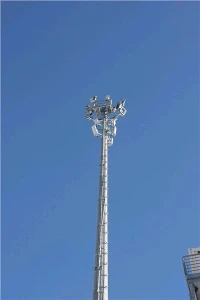
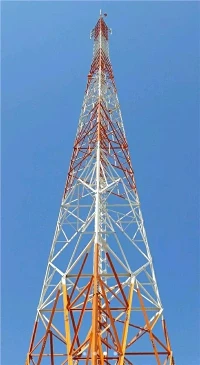
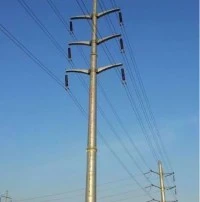
As a supplier of these different types of antennas, I understand that they play crucial roles in various industries. For instance, in the power transmission industry, reliable communication is essential. And that's where good antennas come in handy. If you're involved in power transmission, you might also be interested in some of the related products like 40m Electric Power Transmission Lines Steel Pole, Galvanized 66kv Transmission Line Steel Pole Tower, and 30m Steel Pipe Tower Of Transmission Line. These structures provide the necessary support and infrastructure for efficient power transmission, and proper antenna installation can enhance communication along the transmission lines.
Whether you're looking for antennas for a small home project, a large - scale industrial application, or something in between, we've got you covered. We've spent years in the business, and we're confident that our antennas are of the highest quality and performance. They're designed to work well in different environments and frequency ranges. So, if you're in the market for antennas, don't hesitate to reach out. We're more than happy to discuss your requirements, provide technical advice, and give you a quote. Let's work together to get you the best antennas for your needs.
In conclusion, different types of antennas work based on their unique designs and physical principles. From the simple dipole to the complex parabolic antenna, each one has its own set of advantages and applications. And as a supplier, I'm always excited to share my knowledge and help customers find the right antenna solutions. So, if you think we might have what you're looking for, drop us a line, and let's start the conversation about your antenna needs.
References:
- "Antenna Theory: Analysis and Design" by Constantine A. Balanis
- "Radio Frequency Electronics: Circuits and Applications" by Rudolf F. Graf