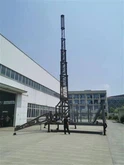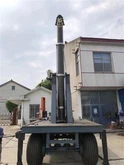


The communication tower can be divided into a ground communication tower, a roof communication tower, also known as a communication tower, a communication tower, and a tower body material, which can be made of angle steel or steel pipe, and has a height ranging from 3 meters to 150 meters. 1) Pile foundation is the foundation of the pull tower of the cable tower, the independent base is the center of the tower. 2) Communication tower: main technical parameters: wind speed 25m/s-35m/s, ice-covered 5-6mm, grounding resistance ≤ 4Ω; vertical Degree ≤1/1000-1/5000 Earthquake resistance level 7-8, safety factor 4 times. 3) Communication tower is mainly used for mobile / Unicom / Netcom / Public Security / Force / Railway / Broadcasting and other departments to set up signal transmission antenna or microwave Transmission equipment, so this tower is also called microwave tower 4) Base station communication tower can be divided into self-standing tower and cable tower (mast) due to different structural forms.
The base station tower is divided into ground towers and roof towers due to different locations. The tower is usually made of a tower type angle steel tower, a steel tube tower (four-column or three-column), a steel single-tube tower, and a pull tower (mast). The angle steel tower is the most common tower type. It is easy to manufacture and install, and it is economical and suitable. It should be the first choice for iron tower construction. The four-column (or three-column) steel tube can be made very small (about 2m) due to its root opening. It is suitable for narrow sites or close to buildings, but the cost is higher than the angle tower. The single-tube tower is mostly used in urban scenic areas or other places where aesthetics is required, because the single-tube tower feeders and personnel climbing are inconvenient. Combined with higher cost, it is only used in special requirements. The advantage of the cable tower is that the amount of steel used is small, but the floor space is large, and whether the economy should be considered comprehensively.
In addition, the cable communication tower is vulnerable to external force damage. Once the cable is damaged, the tower is inverted; the cable tower is oscillated and horizontally twisted by the wind force, and the base station using microwave transmission is used with caution. The roof tower generally adopts an angle steel tower or a raised frame (ie, a grid). There are two situations in the setting of the tower. First, the load of the tower has been considered in the design of the building and the embedded parts (such as the roof of the telecommunications machine room) have been set. It is to build an iron tower on the old building. In the second case, the original building should be checked, the structure should be modified, and the anchoring measures of the tower should be added.
The roots of the communication towers are often different, and the tower height is also limited. It is also necessary to carefully repair the roof waterproofing layer damaged by the construction. The design should be extra cautious. When the antenna hanging height is not much higher than the building roof (about 10m), a simple roof iron frame can be used to cast a concrete pier as a counterweight at the beam (wall) of the building (calculation of the concrete weight is sufficient to resist the iron roof overturning force) The iron frame is fixed on the concrete pier, which does not need to damage the roof waterproof layer. This method has low cost and simple construction. The roof iron frame can also be fixed by pulling the wire, and the weight of the concrete pier is not used, but the anchoring point of the wire must be treated with caution.