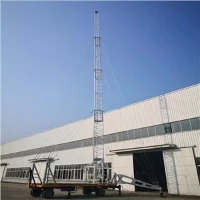


How The Radio Tower Works?
The radio tower is a familiar sight in our modern world. It stands tall, often hundreds of feet in the air, and sends out signals that allow us to communicate with one another over long distances. But how does it work?
At its most basic level, a radio tower is simply a structure designed to hold up an antennae. The antennae is the heart of the system, and is responsible for sending and receiving radio waves. Radio waves are a type of electromagnetic radiation that can be used to carry information over long distances. They travel at the speed of light, and can pass through most materials without being affected.
In order to transmit a radio signal, the antennae must be connected to a transmitter. The transmitter converts the information to be sent into a series of electrical pulses, and sends those pulses out through the antennae as radio waves. The radio waves then travel through the air until they reach a receiver.
The receiver is another antennae, usually located somewhere else. It is designed to pick up the radio waves and convert them back into the original electrical signals. These signals are then passed along to some other device, like a radio receiver, a computer, or a phone.
In order for the transmitter and receiver to communicate effectively, they must be tuned to the same frequency. A frequency is simply the rate at which the radio waves oscillate, or vibrate, as they travel through the air. By adjusting the antennae and the transmitter to the same frequency, they can communicate with one another over long distances.
The height of the radio tower is also important. The higher the tower, the further the radio waves can travel before they start to lose strength. This is because radio waves spread out in all directions as they travel, and the higher the tower, the less they spread out.
Another important factor is the terrain over which the radio waves are traveling. Radio waves can be blocked or absorbed by buildings, hills, or other obstacles. This means that radio towers are often placed on high ground, like a hill or a mountain, in order to maximize their range.
In addition to transmitting and receiving radio waves, some radio towers also serve as a base station for cell phone networks. In this case, the tower is equipped with specialized equipment that enables it to communicate with the cell phones in its coverage area. This equipment includes antennas, transmitters, and receivers, as well as computers that manage the flow of data to and from the phones.