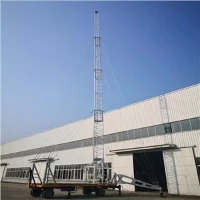


Communication towers have become ubiquitous in the modern landscape. They are tall structures that are used for transmitting and receiving communication signals over long distances. These towers are typically erected and maintained by telecommunication companies, and they play a vital role in providing uninterrupted communication services worldwide. This article will provide an overview of communication towers, including how they work, their location, and their impact on the environment.
How Do Communication Towers Work?
At the highest point of the tower, there is a transmitting antenna, which sends radio waves or other electromagnetic signals. The signals then travel through the air to the receiving antenna on another tower or an electronic device, such as a phone or a television. The received signals are then decoded or converted into information, allowing users to communicate or receive data.
There are different types of communication towers, such as self-supporting towers, guyed towers, and monopole towers. Self-supporting towers are designed to support their weight and the weight of the antennas at the top, while guyed towers rely on cables anchored to the ground to keep them upright. Monopole towers are single-pole towers that are often used in urban areas where space is limited.
Where are Communication Towers Located?
Communication towers are located in various places, ranging from urban areas to remote locations such as mountaintops and deserts. The location of a tower depends on several factors, including the population density, terrain, and the range of radio frequencies the tower needs to cover.
In urban areas, communication towers are often disguised to blend in with the surrounding environment. They may be designed to look like trees, flagpoles, or even sculptures. In areas where there is no need for concealment, towers may be erected in their natural form.
The Impact of Communication Towers on the Environment
Communication towers have both positive and negative impacts on the environment. On one hand, they help facilitate communication, enabling people to connect from anywhere in the world. On the other hand, they can have negative environmental impacts.
The construction and maintenance of communication towers can affect local ecosystems, especially in remote areas. For instance, building roads and power lines to reach remote towers can alter habitats, while tower lighting can interfere with the migration patterns of birds. Additionally, tower waste, such as batteries and electronic equipment, may cause pollution if not disposed of properly.
Communication towers play a vital role in enabling modern-day communication, allowing people to connect and exchange information around the world. The towers are typically constructed and maintained by telecommunication companies, and their design depends on their location and function. While communication towers may have negative impacts on the environment, it is essential to recognize their significance in enabling global communication. As such, it is important to implement measures to minimize their environmental impact and ensure their sustainability for the future.