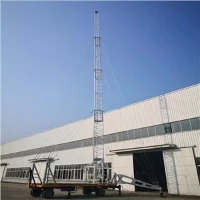


Communication towers are essential components of modern communication systems. These structures provide support for everything from cell phone networks to TV and radio broadcast systems. Communication towers are typically designed to be tall and sturdy, and they must be able to withstand strong winds and other environmental factors. One of the key components of any communication tower is the foundation that supports it.
The foundation is the part of the tower that is in contact with the ground. It is responsible for providing stability and support for the entire structure. The foundation must be able to support the weight of the tower, the equipment that is mounted on it, and any wind or environmental forces that may act on it. The foundation must also be able to distribute these loads safely and evenly into the surrounding soil.
There are many different types of communication tower foundations, each of which has its own advantages and disadvantages. Some of the most common types of foundations include:
1. Pad Foundations
Pad foundations are the simplest type of foundation and are typically used for smaller communication towers. The foundation consists of a concrete pad that is poured directly onto the ground. The pad is generally square or rectangular in shape and is designed to distribute the load of the tower and its equipment across a large area. Pad foundations are relatively inexpensive and easy to construct, but they may not provide enough stability for larger towers or towers located in areas with unstable soil.
2. Pier Foundations
Pier foundations are used for taller towers or towers located in areas with unstable soil. The foundation consists of a series of concrete piers that are set deep into the ground. The piers are connected to each other and to the tower by a concrete beam or mat. Pier foundations are more expensive than pad foundations, but they provide greater stability and can be used in a wider range of soil conditions.
3. Raft Foundations
Raft foundations are similar to pad foundations, but they are designed to support larger loads. The foundation consists of a large concrete slab that is poured directly onto the ground. The slab is generally thicker than a traditional pad foundation and is reinforced with steel bars. Raft foundations are typically used for larger, heavier communication towers or towers located in areas with soft or unstable soil.
4. Caisson Foundations
Caisson foundations are used for very tall towers or towers located in areas with rocky or uneven soil. The foundation consists of a series of steel or concrete columns that are drilled deep into the ground and filled with concrete. The columns are connected to each other and to the tower by a concrete beam or mat. Caisson foundations are the most expensive type of foundation, but they provide the greatest stability and can be used in a wide range of soil conditions.
Regardless of the type of foundation that is used, it is important that the foundation be designed and constructed by experienced professionals. Proper design and construction are essential for ensuring the stability and safety of the tower and its equipment. Communication towers play a critical role in modern communication systems, and their foundations are an essential component of these structures.