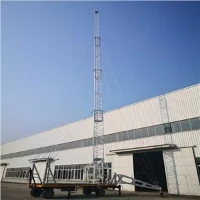


Communication Tower Types
Wireless communication networks utilize various types of towers based on their functionality, height, and location. Standard communication towers include:-
1. Self-Supporting Towers
These towers are freestanding and need no external support to stay erect. Self-supporting towers can be configured using different materials like steel, aluminum, or a combination of both.
2. Lattice Towers
Lattice Towers are structures with diagonal beams that form an interlocking grid. These towers are lightweight, and their design allows them to remain stable, even in adverse weather conditions.
3. Monopole Towers
Monopole Towers are made up of a single pole or a column reinforced with multiple struts or guy wires. The structures are straightforward to maintain but lack the height necessary for larger service coverage.
4. Rooftop Towers
Rooftop towers are used in urban areas as an alternative to traditional towers, where space is limited. These towers are disguised as building features and blend well with the city skyline.
5. Camouflaged Tower
Camouflaged Tower is a tower design that uses different elements like trees or monopoles to hide the tower and create the illusion of a natural surrounding.
Communication Tower Connectivity
Communication towers provide access to wireless communication networks, connecting users to mobile networks within their location. The towers require expert installation and maintenance to ensure the best possible speed, signal strength, and reliability. Smaller communication towers can serve single neighborhoods, while larger towers or clusters can offer coverage to extensive geographical areas.
Communication Tower Benefits
Communication towers contribute to supporting the efficiency of wireless communication networks by providing the necessary infrastructure to keep users connected. The benefits of deploying communication towers include:-
1. Expand Coverage
Communication towers help to provide communication coverage where none exists. The tall structures can be deployed to reach remote areas and provide communication access to underserved communities.
2. Enhance Network Capacity
Communication towers can help to increase network capacity by enabling the provider to add more antennas and equipment, resulting in better signal quality, higher data speeds, and more reliable network coverage.
3. Diversify Coverage
Communication towers can provide a backup or a secondary network coverage for users in case of network congestion or a network outage.