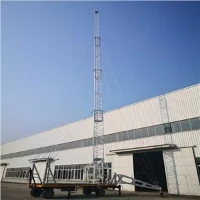


What is a transmission structure?
The transmission structure is one of the most visible elements in a power transmission system. They support the conductors used to transmit power from the power generation source to the customer's load. Transmission lines carry electricity over long distances at high voltage, typically between 10kV and 500kV.
There are many different designs of transmission structures. Two common types are:
Lattice Steel Tower (LST), which consists of a steel frame consisting of individual structural components bolted or welded together
Tubular Steel Rod (TSP), which is a hollow steel rod manufactured in one or several pieces assembled together.
Both LSTs and TSPs can be designed to carry one or two circuits, known as single-circuit and dual-circuit configurations (see example above). Dual circuit configurations typically keep conductors in a vertical or stacked configuration, while single circuit configurations typically keep conductors horizontal. Due to the vertical configuration of the conductors, the double loop structure is taller than the single loop structure. On low-voltage lines, structures sometimes carry more than two circuits.
A single-circuit alternating current (AC) transmission line has three phases. At low voltages, one phase usually consists of one conductor. At high voltages (over 200 kV), a phase can consist of multiple conductors (bundled together) separated by short spacers.
The double-circuit AC transmission line has two sets of three-phase.
Terminal towers are used at transmission line ends; where transmission lines have large corners; on each side of major intersections, such as large rivers, highways, or large valleys; or along straight sections to provide additional support at intervals. A dead-end tower differs from a suspension tower in that it is more rigid in construction, usually has a wider base, and has stronger strings of insulators.
Structural dimensions vary by voltage, terrain, span length and tower type. For example, dual-circuit 500 kV LSTs typically range in height from 150 to over 200 feet, while single-circuit 500 kV towers typically range in height from 80 to 200 feet.
Dual-loop structures are taller than single-loop structures because the phases are aligned vertically and the lowest phase must maintain minimal ground clearance, while single-loop structures have phases aligned horizontally. As the voltage increases, the phases must be separated farther apart to prevent any chance of interference or arcing. Therefore, the high-voltage towers and poles are taller and the horizontal arms are wider than the low-voltage structures.