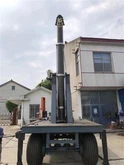


Have you ever wondered how the phone in your pocket transmits your voice to another phone and vice versa? While the components in your phone perform a lot of work, cell towers do most of the heavy lifting in wireless communications.
But what exactly are cell phone towers? How do they work? Read on to find the answers to these questions and more.


What is a cell phone tower?
A cell tower is a specialized structure that transmits and receives cellular signals within an existing cellular network. Cellphone or telecom towers are also the structural foundation of these networks - each tower forms a unique node that can connect to other cellphone towers within the same network or even across networks.
Cell phone towers, also known as base transceivers, use a variety of important components to receive and transmit radio signals. Depending on the specific tower and location, a given cell tower can create and receive signals on specific frequencies or for specific purposes.
But all cell phone towers use electricity to generate radio waves at target frequencies. Each phone is tuned to a certain frequency range or band based on the phone's carrier, features and other attributes. Most cell towers are between 50 feet and 200 feet tall.
Cell sites, base stations, and towers are closely related to the FCC, or Federal Communications Commission, as they impact cellular, wireless service, and Wi-Fi availability. Big companies like AT&T, T-Mobile and Verizon run their wireless networks on a network of many different towers.
Recently, 5G cell towers have been built or upgraded to create 5G networks with greater data bandwidth and stronger cell phone signals. Despite rumors, these cell towers do not pose any health risks (even though there are claims of side effects from the new towers' non-ionizing radio frequency radiation).
What are the main types of cell phone towers?
Technically, four types of cell towers make up most major networks. These include:
Lattice tower. These are also called self-supporting towers. Lattice towers have three or four sides and are very flexible/multifunctional.
Monopole tower. These are monolithic tubular towers made of steel or concrete, usually less than 50 m in height.
Guyed tower. These are typically 100 m or larger and are connected by large "guys" that anchor and support the infrastructure. These towers make up the majority of broadcast and television towers.
Invisible tower. These are more expensive but have additional aesthetic or landscaping elements that make them more visually appealing.
What are the key components of a cell phone tower?
Cell phone towers must work thanks to a specific arrangement of basic components, including:
Heating or air conditioning unit
Antennas and other equipment
dynamo
Backup generator
Telephone lines are usually made of fiber optics
safety equipment
All cell tower sites require radio equipment and antennas to transmit radio signals. Most towers have extensive generators, capacitors, and air conditioning units to keep the towers relatively cool. Even in fairly cold climates, these generators can make cell tower sites very hot.
How do cell towers work?
Now let's take a closer look at how cell towers work. We'll explore this by looking at an example of a typical call made from your mobile phone.
First, your phone emits electromagnetic radio waves. These are called radio frequency or "RF" signals. The cell tower closest to your phone picks up the RF signal and transmits it farther along the network. Cell phones are two-way radios that can send signals to and receive signals from cell tower antennas.
When your phone sends a signal to the nearest cell tower, it creates an uplink. At the same time, if a cell tower sends your signal to a new phone, it creates a downlink. These are similar to uploading and downloading other data and information, but the uploading and downloading activities use different radio frequency signals and therefore do not interfere with cellular signals.
It is crucial that you and the person you want to talk to are using the same radio frequency in order to listen and communicate.
Turn words into signals
Cell towers receive signals from your cell phone, including the electromagnetic signature of your voice. It then converts these signals into electromagnetic waves. Cell phone tower antennas convert these radio frequency signals into different light pulses.
Next, the light pulses are sent to the base transceiver box at the base of the tower. At this stage, the real scientific magic begins. Cell towers can send these signals around the world at the speed of light.
The process is reversed once the signal reaches the target tower (usually the tower closest to the target conversation partner). The light pulse leaves the base station transceiver box and returns to the antenna, where it is transmitted as a radio frequency signal.
How do cell towers forward calls to your cell phone?
Without getting too technical, cell towers direct calls to your phone like this:
First, multiple cell towers in a specific area are connected to a mobile switching center, or MSC. This central point is interconnected by wires from the many cell phone towers in the surrounding area.
Each MSC has various SIM cards registered to it. This is why every phone has a "main" MSC. The home MSC stores information about each phone, such as service plan, location, and activity status.
If you leave the range of your home MSC, any new MSCs in your vicinity will communicate electronically with your home MSC. This way, you can always track your location no matter where you go.
Regardless, as long as your phone is powered on and within range of a cell tower, the cell tower can use radio frequency signals to identify your unique phone. When someone calls your phone, the nearest MSC routes the call to your phone. This can happen when your phone starts "roaming," which may incur additional charges.
In this way, people can send and receive calls from anywhere around the world, even if they are not near their "home" tower.
What is the coverage range of cell towers?
Of course, we've all been in situations where we can't connect to a local cell tower and therefore can't make a call. You may be wondering what the average cell tower coverage is.
This varies from place to place. The range of cell phone towers is not fixed and will be affected by the following factors:
The height of a given cell tower antenna
The frequency of the mobile signal your phone uses
Phone and cell tower transmitter power
Weather conditions around cell phone towers
How different buildings reflect or absorb radio energy
Your mobile device's uplink and downlink data rates
Generally speaking, cell towers are spaced about 1 to 2 miles apart in suburban areas and 0.25 to 0.5 miles apart in metropolitan areas. In rural areas with flat terrain, cell towers may be spaced between 30 and 45 miles apart. In hilly areas, cell towers may be only 3 to 5 miles apart.
In all of these cases, the average range of a given cell tower may be anywhere from a few miles to dozens of miles. It all depends on the factors mentioned above!
Also, keep in mind that many cell phone towers are placed close to each other to handle the increased traffic.
For example, metropolitan areas have many cell phone towers that are very close together because many people make calls from these cell towers all the time. In some cases you may not be able to get through due to heavy traffic, although this is very rare in practice.