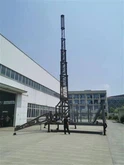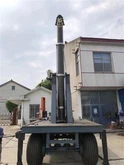


What is a cable tower?
Guyed Tower Construction A Guyed Tower is a light to heavy duty communications tower constructed of straight rods arranged in a triangle but supported by wires at all angles. Pull-wire towers are particularly tall, up to 2,000 feet, and are often used to keep antennas high above the ground for greater signal strength and cellular reception.
In addition to cellular use, they can also be used for radio and television use. They are ideal for rural customers who need maximum height at an economical cost.
Partial pylons and additional pylons
Partially guyed towers consist of guyed masts on top of a stable, self-contained structure. Wires can be attached to the top of the structure or to the ground.
An additional guy tower adds support wire. They can be attached temporarily for added stability (such as during construction) or only in one direction to support unidirectional shear stress.
An example of this might be a pole at the end of a power line that ends or slopes in the other direction. Only people in one direction are needed to support an unbalanced load of power lines in the other direction.
other types of towers
In addition to the cable tower, other variants can be used depending on the project requirements. These include:
monopole tower
A single tubular mast includes this type of cellular tower; due to the instability introduced by the use of a single mast, these structures do not exceed 200 feet in height. One benefit of this type of tower is that it requires very little floor space to erect, and the antenna can simply be mounted outside the top of the mast.
lattice tower
Lattice towers, also known as "free-standing towers," are usually made of steel and are triangular or square in shape. These towers generally offer the most stability and flexibility compared to other cellular tower types.
Stealth Tower
Stealth towers can be deployed to meet zoning regulations. They are more expensive than other towers because they require extra material to create a hidden appearance. Their smaller size generally makes them less efficient.
Have you ever seen a painted metal tree standing tall on the side of a highway? This is a familiar example of a stealth tower. This type of structure is used whenever a tower might need to be hidden from view. They're designed to ensure they blend in with their surroundings, as many see exposed cell towers as ugly, or an intrusion. These towers can take the shape of many other objects, such as signs, flagpoles, and even cacti!