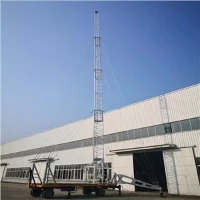


Reasons for strand breakage of tension pole tower
Tensile poles are towers that use tensile insulators to suspend or separate wires. In addition to supporting wires and overhead ground wires, they also bear the tension of these wires. In addition to the gravity and wind supporting the conductor and the overhead ground wire, the stretching pole also bears the tension of these wires. The conductor and the overhead grounding wire are disconnected at the tension pole and located in the line segment where the conductor and the overhead grounding wire are in a straight line. This line segment is used to reduce the length of the continuous gear along the longitudinal direction of the gearbox to facilitate the construction and maintenance of the pipeline, and The control pipeline can be dropped in series along the longitudinal tensile tower. Tension poles can be divided into tensile linear rods, tensile angle rods and terminal posts. The following introduces the reasons for the strand breakage of the tension pole tower.
Tower
The power line joints of tensile poles can be divided into tensile joints and non-tensile joints according to their performance. A tensile joint is a joint that bears the full tension of the steel wire. Non-tensioned joints refer to joints used for alternating current, including T-clamps, equipment clamps and hook clamps. This kind of joint does not require high mechanical strength, but has very strict requirements on electrical performance. With the increase in the running time of the production line, the tension poles have been drained and disconnected many times, which seriously affected the safe operation of the production line.
The reasons for the fracture of the transmission line strands of the tension pole tower can be analyzed from two aspects: thermal effect and contact resistance.
1. Thermal effect
Due to the thermal effect of the current, when the power load changes and the climate changes in winter and summer, it will cause the joint temperature to change. The contact surface is continuously heated and expanded and contracted, making the joint worse, increasing the resistance, and the resistance of each temperature cycle increases. It will also increase the heat in the next cycle, especially when the load is large, which may cause the drain joint of the tensile tower to overheat or even burn.
2. Contact resistance
The connection principle of the drain joint of the tension pole is to reduce the contact resistance of the joint by applying pressure on the contact surface to achieve the purpose of safely transmitting the specified load current. Therefore, the joint should first consider how to reduce the contact resistance. The increase in contact resistance increases power loss and causes temperature rise. Corrosion and oxidation are intensified at high temperatures, which further reduces the quality of the connection, and most leads to the breaking of the tension pole and even burning.