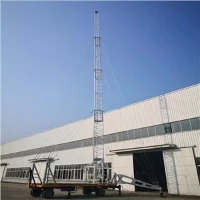


How to do lightning protection measures for communication towers
When the base station communication tower exceeds a certain height, the number of lightning strikes increases in proportion to the square of the height of the communication tower. That is to say, after the communication tower exceeds a certain height, the chance of lightning strikes will increase significantly. The formula for estimating the number of lightning strikes (N) of communication towers per year is: N=ng(CH+h)2 D×102 (times/year); where: ng — lightning density on the ground; C — terrain coefficient; where: mountain top When the communication tower is surrounded by open ground and the mountains are steep, C=0.3; when the surrounding is open ground and the mountains are not steep, take 0.2; in other cases, C=0.1~0.2.
When the non-mountain communication tower is surrounded by open ground and the mountain is not steep, C=0.1, and the communication tower on flat ground C=0; otherwise, it is 0.05. H—the average difference between the location of the communication tower and the ground level within a radius of 1 km (m); h—the height of the communication tower; D—the iso-thunderline value of the area where the communication tower is located. According to the situation of mobile communication base stations in my country, especially in the southern region, lightning strikes on communication towers are one of the three main ways to damage base station equipment (communication tower antenna feeder, overhead power line or communication line). Therefore, communication towers should be equipped with complete lightning protection devices against direct lightning and secondary induction lightning. The lightning protection belt must conform to the design and related specifications. Generally, two 40×4mm thermal lightning rods are used to draw down from the tower top. Galvanized flat steel (minimize the intermediate connection as much as possible, and be more than 1.5m away from the power line, communication line, and gas pipeline), and be fixed reliably with the tower body, and the welding is qualified. The welding place should have reliable anti-corrosion measures, and the direction should be reasonable and meet the requirements. The lightning rod on the top of the tower is generally a galvanized steel pipe with a pointed top and a height of about 7 meters. It should be installed firmly. Ensure that the antenna is within the 45-degree protection range of the lightning rod.
The obstruction lights of the communication tower are generally set on the top of the tower with 2 to 4, red 100W, if AC power is used, the power cord must be a shielded wire, and the upper and lower ends of the outer shield should be grounded. Solar cells are now used as energy sources, and corresponding lightning protection measures should also be taken. At the same time, it needs to be handled in accordance with the regulations of the Ministry of National Defense and the Civil Aviation Administration. Supervisors should check the installation of the lightning rod (net) of the communication tower and its supporting parts. It is required to be correctly positioned, firm and reliable, with good anti-corrosion performance, and the vertical deviation of the needle body is not greater than the diameter of the top needle rod. The size and bending radius of the lightning protection net are correct, the supporting parts are evenly spaced, the production quality of the lightning rod and its supporting parts should meet the design requirements, and the marking needles and navigation lights should be complete and clearly displayed.
To ensure that the antenna is within the effective protection area of the lightning rod, the effective protection radius (R) of the lightning rod can be calculated by the following formula: R(1.6h3×P)/(1+h2/h1); where: h1--- -Is the height of the lightning rod (m) h2---- is the height of the protected object (m) h3---- is the effective height of the lightning rod (m), h3=h1-h2 R--- is the height of the h2 plane Protection radius (m); P--- is a coefficient, when h1<30m, P=1; when h1>30m, P=5.5; In the range of radius R, all equipment whose height does not exceed h2 can be Be protected.