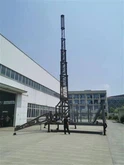


How to choose a tower type
When choosing the type of tower for your deployment, there are usually four main considerations:
Antenna load
Tower footprint tower
high
budget

Antenna load tower
The antenna load capacity depends on the structure of the tower. The greater the surface area of the antennas, coaxial cables, brackets, and other equipment installed on the tower and exposed to the wind, the greater the strength of the tower.
To ensure that the load added by your equipment is below the maximum allowable value of the tower, you must estimate the effective wind load of the equipment.
The wind load is proportional to the area of the exposed structure and the distance from the attachment to the ground. The curved and perforated shapes (grid and truss) provide less wind resistance and are therefore more suitable for achieving low wind loads. Solid tableware is easily affected by wind loads and should be avoided in windy environments.
The average wind speed of the site must also be considered. The average wind speed depends on the location of the site on the earth, the altitude and the type of environment (rural or urban). Online statistics can be obtained from meteorological agencies.
There are many ways to calculate wind loads, and some are better than others. The latest IEA222 standard specification specifies the "latest" and possibly the most accurate method.
Tower footprint tower footprint
Is the amount of free space on the ground required for installation. Depending on the structure of the tower, it requires more or less installation space.
For high tie rod masts (>100 feet, 30 meters), each tie rod anchor is usually 1015 meters from the bottom of the mast. For a mast with 3 guy wires on each floor, its area is about 90,200 square meters.
The height of the tower
If you need a structure less than 40 feet, you can actually eliminate the cost and extra work required to pull the wire. Instead, you can even install the tower on the roof of a house or garage.
As mentioned earlier, adding cables to the structure will allow for higher heights.
budget
The general rule of thumb is:
"The smaller the tower base, the higher the cost of purchasing and installing the tower."
The monopole antenna has the smallest footprint of all towers, so it is the tower type with the highest installation cost. The second is the self-supporting tower, and then the guyed mast that requires the largest footprint.
In addition, depending on the tower type you choose, certain tools, machinery, and cranes are required to assemble the tower, which must be considered in the final budget.