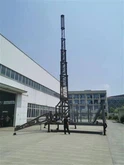


Telecommunication towers, also known as cell towers, receive and transmit radio waves to facilitate wireless communication between mobile devices. These towers enable users to make phone calls, send text messages and access the internet, even as they move from one place to another. Towers create a network of cells, or coverage areas, to ensure people stay connected wherever they may be.
Cell towers have the same components, but they come in several different forms to suit the area's coverage needs. Learn more about how these towers work, what it takes to build one, and how Aluma Towers can assist you with your telecom tower requirements.
Types of Cell Towers
Telecommunication towers come in several forms to meet various location and coverage needs.
1. Guyed Towers
Guyed towers are supported by guy wires anchored to the ground in all directions. They are the most common type of cell tower because they have a slender, lightweight design while still providing stability. They are a cost-effective option for medium heights, though they require a substantial amount of land for the guy wire anchors.
2. Unguyed Towers
As the name suggests, unguyed towers do not need any guy wires. These freestanding towers require robust construction to withstand wind and weather. They are suitable for areas with limited space for guy wire anchoring.
Unguyed towers include monopoles and lattice towers. Monopoles are single, freestanding poles often found in urban and suburban areas that usually reach 50 to 200 feet. Lattice towers are triangular- or square-shaped self-supporting towers that can reach greater heights than monopoles, usually 200 to 400 feet.
3. Open Trailer Towers
For temporary or emergencies, an open trailer tower is ideal. The tower is mounted onto a trailer, making it quickly deployable for harsh or remote locations. They often come with hydraulic or pneumatic masts for easy setup and teardown.
4. Cell-on-Wheels (COW)
A COW is a portable cellular site on a wheeled platform. It is easy to tow on short notice for temporary needs, such as network expansion, disaster recovery or events. They are often equipped with generators and backup power systems to provide rapid and convenient solutions for needs in remote areas or across rough terrain.
5. Stealth Towers
Stealth towers are disguised to blend in with their surroundings due to local zoning regulations or aesthetic concerns. They may be designed to look like trees, flag poles, clock towers, church steeples, cacti or existing structures or signs. Constructing these towers often requires additional materials to help them hide in plain sight, and they are usually smaller and less efficient.