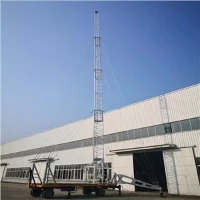


One of the main complaints about mobile masts and cell phone towers is that they damage the local environment-they just look out of place, and in many cases are very ugly. In 2014, a survey conducted by the National Institute of Science, Law, and Public Policy in the United States found that 94% of people are unlikely to buy real estate close to cell phone towers. Real estate prices have a negative impact.

Cell towers and antennas need to be in someone’s backyard, otherwise there will be no mobile network. So what would you do? Disguise cell phone towers.
A large number of companies have sprung up, and they have different views on the overall aesthetics of antennas and towers.
It has become a skill to make antennas and cell phone towers that can be integrated into existing urban or rural environments. For example, in Dubai, cell phone towers are now disguised as palm trees, which is convincing to be honest.
Naturally, as the demand for bandwidth continues to increase, more and more cellular base stations become necessary, and we will need more antennas and cellular towers as part of our modern landscape. A report two years ago indicated that in the United States, where the number of websites decreased during market consolidation, new technologies will drive a compound annual growth rate of 3.9% by 2025.
Therefore, it makes sense to try to integrate them with whatever environment you happen to be in. In the UK, some suppliers have also begun to disguise mobile masts as trees, but not palm trees-this seems a bit out of date. Typical English rural environment-they camouflaged them with local varieties of leaves, as shown in the photo taken in Branford. Can you see which one is the mobile antenna? (Hint: it is the tallest on the right).