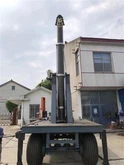



Definition: Tower and Mast:
In engineering terms, a tower is a self-supporting structure, while a mast is supported by struts or struts.
The terms "tower" and "mast" are often used for the same type of structure, which of course can cause confusion. Towers and masts are defined differently in American and British English. In American English, both structures are often called towers, while in British English people always use masts instead.
To avoid this confusion, in this unit we use engineering terminology:
tower = self-supporting
Mast = supported by poles or people.

Types of towers and masts:
This section describes the three most common tower/mast types used in wireless communications today; free-standing towers, monopoles, and guyed masts.
Monopole Tower:
Monopoles are hollow conical rods made of galvanized steel. They are constructed of slip-connected welded pipe up to 200 feet (60m). Due to their structure, they are expensive to manufacture but simple to install.
Monopoles are mainly used in urban environments, where the space available for the tower base footprint 2 is limited. The maximum footprint for a 200-foot monopole is approx. 6x6 feet (2x2 m)
Self-supporting tower:
Self-supporting towers (freestanding towers) are built without guy wires. Self-supporting towers have a larger footprint than monopoles, but still require a much smaller area than guyed masts.
Due to their relatively small footprint, such towers are often found in cities or other places where free space is scarce.
Self-supporting towers can be constructed with three- or four-sided structures. They are assembled in sections, with a lattice structure of beams bolted to three of the four inclined vertical tower legs.
The wider the tower base, the greater the acceptable antenna load.
Pull Wire Mast:
Guyed masts are secured with guy wires that are attached to a set of concrete bases on the ground.
Guyed masts consist of identical three-sided sections (approximately 10 feet (3m) each) stacked on top of each other. For example, unlike a monopole, a guyed mast does not taper as it goes up because each section is the same width.
This mast has a large footprint thanks to these guys. Conversely, guyed masts can be taller than non- guyed towers and allow for larger antenna loads.
Pull-wire masts are ideal for most communications needs, including wireless internet, cellular and antenna radio towers.