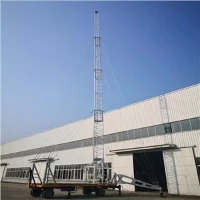


The telecommunication tower industry is expanding rapidly to meet the growing demand for wireless communication and internet services. Technological advancements have led to the deployment of 5G networks, resulting in an increase in the number of cell towers required to provide high-speed connectivity across diverse locations.
With the proliferation of smart devices and the internet , the telecommunication tower industry is expected to experience significant growth in the coming years. This will lead to the construction of new towers and the upgrading of existing infrastructure to meet the needs of businesses, governments, and individuals.
1. Tower Types: There are many types of communication towers such as lattice towers, monopole towers, guyed towers, and self-supporting towers. Each type has its unique features and applications depending on the specific needs of the communication industry.
2. Tower Materials: Communication towers can be constructed from various materials, including steel, reinforced concrete, and fiberglass. Each material offers different benefits in terms of durability, cost, and weight.
3. Tower Installation: Installing a communication tower requires specialized equipment and expertise. Tower installation involves many steps, such as site preparation, tower foundation creation, and tower assembly.
4. Tower Maintenance: Regular maintenance is crucial for ensuring the longevity and reliability of communication towers. Maintenance tasks include visual inspections, cleaning, and repairs.
5. Tower Safety: Communication towers can be dangerous structures to work on due to their height and exposure to the elements. Proper safety precautions, such as the use of personal protective equipment (PPE), must be taken when climbing or working on these structures.
6. Tower Regulations: Communication towers are subject to various regulations from local, state, and federal authorities. Compliance with these regulations is necessary to ensure that the tower is constructed and maintained safely.
7. Tower Design: Communication towers must be designed to withstand various environmental factors, such as wind and earthquakes, and to support the weight of the equipment mounted on them. Tower designers must consider these factors when designing the tower to ensure its structural integrity.
8. Tower Mounting: Communication towers can support various equipment, such as antennas, repeaters, and transmitters, depending on the needs of the communication industry. Proper installation and mounting of equipment is necessary to ensure optimal performance of the tower and the equipment it supports.
9. Tower Lighting: Communication towers must be lit to warn nearby aircraft of their presence. The type of lighting used depends on the height and location of the tower.
Communication towers offer many advantages for the modern world. They provide the necessary infrastructure for wireless communication, which has become ubiquitous in our daily lives. Here are some of the major advantages of communication towers:
1. Improved Connectivity: Communication towers significantly enhance connectivity by providing better signal strength, call quality, and faster data transfer rates. This is especially important in remote or less-populated areas, where traditional communication infrastructure is often inadequate or absent.
2. Cost-Effective: Communication towers are a cost-effective way to extend network coverage compared to building costly wired infrastructure. It’s much easier and faster to add new towers to improve coverage than it is to build new physical networks.
3. Greater Capacity: Communication towers can support a large number of users simultaneously, which is essential for busy areas like shopping centers, airports, and sports stadiums. The increased capacity of a communication tower helps to reduce network congestion and ensures a more reliable connection.
4. Flexibility and Versatility: Communication towers can be installed in various locations, such as rooftops, hills, and remote areas. They can also be used to support different types of wireless technologies like 2G, 3G, 4G, and even 5G.
5. Emergency Preparedness: Communication towers are crucial during emergencies and natural disasters. They enable communication between emergency responders and the affected population, facilitating faster response and reducing damage and loss of life.