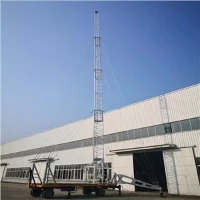



The International Association of Fire Fighters' position on locating cell towers commercial wireless infrastructure on fire department facilities, as adopted by its membership in August 20041, is that the IAFF oppose the use of fire stations as base stations for towers and/or antennas for the conduction of cell phone transmissions until a study with the highest scientific merit and integrity on health effects of exposure to low-intensity RF/MW radiation is conducted and it is proven that such sitings are not hazardous to the health of our members.
Further, the IAFF is investigating funding for a U.S. and Canadian study that would characterize exposures from RF/MW radiation in fire houses with and without cellular antennae, and examine the health status of the fire fighters as a function of their assignment in exposed or unexposed fire houses. Specifically, there is concern for the effects of radio frequency radiation on the central nervous system (CNS) and the immune system, as well as other metabolic effects observed in preliminary studies.
It is the belief of some international governments and regulatory bodies and of the wireless telecommunications industry that no consistent increases in health risk exist from exposure to RF/MW radiation unless the intensity of the radiation is sufficient to heat body tissue. However, it is important to note that these positions are based on non-continuous exposures to the general public to low intensity RF/MW radiation emitted from wireless telecommunications base stations. Furthermore, most studies that are the basis of this position are at least five years old and generally look at the safety of the phone itself. IAFF members are concerned about the effects of living directly under these antenna base stations for a considerable stationary period of time and on a daily basis. There are established biological effects from exposure to low-level RF/MW radiation. Such biological effects are recognized as markers of adverse health effects when they arise from exposure to toxic chemicals for example. The IAFF's efforts will attempt to establish whether there is a correlation between such biological effects and a health risk to fire fighters and emergency medical personnel due to the siting of cell phone antennas and base stations at fire stations and facilities where they work.
Some base stations use antennas that look like poles, 10 to 15 feet in length, that are referred to as "omni-directional" antennas. These types of antennas are usually found in rural areas. In urban and suburban areas, wireless providers now more commonly use panel or sector antennas for their base stations. These antennas consist of rectangular panels, about 1 by 4 feet in dimension. The antennas are usually arranged in three groups of three antennas each. One antenna in each group is used to transmit signals to wireless phones, and the other two antennas in each group are used to receive signals from wireless phones.
At any base station site, the amount of RF/MW radiation produced depends on the number of radio channels (transmitters) per antenna and the power of each transmitter. Typically, 21 channels per antenna sector are available. For a typical cell site using sector antennas, each of the three transmitting antennas could be connected to up to 21 transmitters for a total of 63 transmitters. When omni-directional antennas are used, a cellular base station could theoretically use up to 96 transmitters. Base stations used for PCS communications generally require fewer transmitters than those used for cellular radio transmissions, since PCS carriers usually have a higher density of base station antenna sites.
The electromagnetic RF/MW radiation transmitted from base station antennas travel toward the horizon in relatively narrow paths. The individual pattern for a single array of sector antennas is wedge-shaped, like a piece of pie. Cellular and PCS base stations in the United States are required to comply with limits for exposure recommended by expert organizations and endorsed by government agencies responsible for health and safety. When cellular and PCS antennas are mounted on rooftops, RF/MW radiation levels on that roof or on others near by would be greater than those typically encountered on the ground.