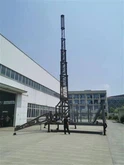


With the rapid development of emerging technologies such as 5G and the Internet of Things (IoT), the demand for wireless communications is growing. As the key infrastructure of wireless communication networks, wireless towers (also known as communication towers and base station towers) undertake the important mission of transmitting wireless signals and realizing data exchange. Understanding the basic definition, function and development trend of wireless towers is particularly important for wireless tower suppliers, which helps to grasp the pulse of the industry and expand market opportunities.
1. Definition and function of wireless towers
Wireless towers refer to tall structures used to support antennas and other communication equipment. The main purpose is to effectively transmit wireless signals to terminal devices within the coverage area. Wireless towers are usually made of steel or concrete. When designing, it is necessary to take into account the height, load-bearing, wind and earthquake resistance and other performance to ensure the safe and stable operation of communication equipment.
The main functions of wireless towers include:
Antenna support: Provide fixed height and space for installing various antenna equipment such as cellular networks, broadcasting, satellites, microwave transmission, etc.;
Signal coverage: With the help of antennas on wireless towers, wide-area signal coverage is achieved to ensure smooth wireless communication for users;
Network interconnection: As a node in the wireless communication network, signal transmission and switching between base stations are achieved to support mobile communications and data services.
2. The core position of wireless towers in wireless communication systems
The core foundation of wireless communication networks is base stations, and the physical carrier platform of base stations is wireless towers. Wireless towers not only determine the coverage and quality of signals, but also directly affect the capacity and stability of the network. With the evolution of wireless communication technology, from 2G, 3G to 4G, and then to today's 5G and the upcoming 6G, the status of wireless towers has always been irreplaceable.
For operators, wireless towers are key resources to ensure continuous and efficient operation of the network. For equipment manufacturers and suppliers, wireless towers are bridges connecting products and markets. Choosing appropriate tower designs and high-quality materials is an important part of meeting customer needs and improving competitiveness.
3. History and development trend of wireless towers
1. Historical evolution
The development history of wireless towers is closely related to wireless communication technology. The earliest wireless towers were mostly simple wooden or steel poles, mainly used for radio broadcasting and basic telephone communications. With the rise of mobile communications, especially the popularity of cellular networks, communication towers have gradually developed into tall, multifunctional steel structure towers.
At the end of the 20th century, communication towers gradually achieved standardized design and modular production, supporting the coexistence of multi-band and multi-operator equipment, meeting the increasingly complex network needs.
2. Development Trend
Multifunctional integration: Modern wireless towers not only bear antenna support, but also integrate optical fiber lines, power supply equipment and intelligent monitoring systems, and develop in the direction of "intelligent base station towers";
Lightweight and environmental protection: High-strength alloy materials and innovative structural design are used to reduce the weight of the tower and construction costs, while reducing the impact on the environment;
Miniaturization and distribution: To meet the needs of 5G high-density coverage, small base station towers and micro towers are quickly laid in cities and special scenarios to supplement the coverage blind spots of macro wireless towers;
Intelligent operation and maintenance: Equipped with sensors and remote monitoring systems, wireless towers can be equipped with real-time status monitoring, fault warning and automatic maintenance to improve operational efficiency;
Green energy utilization: Combined with renewable energy such as solar energy and wind energy, promote the green transformation of wireless tower power supply to meet the communication needs of remote and powerless areas.
Conclusion
As the "skeleton" of wireless communication networks, the quality and performance of wireless towers directly determine the coverage effect and service level of wireless networks. For wireless tower suppliers, a deep understanding of the definition, role and development trend of wireless towers, active application of new materials and technologies, and provision of high-quality products that meet the needs of operators are the key to winning the market and customer trust.
With the continuous upgrading of wireless communication technology, the wireless tower market will usher in more opportunities. Suppliers should keep up with the pace of industry development and continue to innovate to support the construction of more intelligent, efficient and green wireless communication networks in the future.