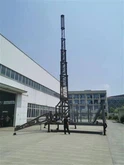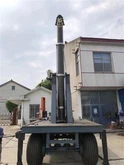


Stability, adaptability, and safety are the premise of every detail
As a type of movable and liftable multifunctional platform equipment, the telescopic trailer tower is widely used in emergency lighting, temporary monitoring, mobile communications, broadcast demonstrations and other on-site occasions. It must not only meet the functional requirements of "rising high and seeing far", but also be able to be pulled, stand firmly, and use safely in various outdoor environments.
Behind this is the core value of the trailer chassis and tower structure design. This article will explain the key engineering design highlights of the telescopic trailer tower from three aspects: the adaptability of the trailer system, the windproof structure design, and the safety control mechanism.
1. Trailer chassis design: flexible trailer, adaptable to a variety of operating scenarios
Trailer system: easily connect to various towing vehicles
The telescopic trailer tower is equipped with a standard trailer interface (such as ball head and ring towing interface), which can be adapted to a variety of models such as pickup trucks, trucks, engineering vehicles, etc., and has good compatibility and road accessibility.
Multi-axis structure optional: single-axis design is suitable for lightweight applications, and double-axis is more suitable for heavy-duty equipment with greater stability.
Parking support legs: Equipped with adjustable mechanical or hydraulic legs to ensure that the equipment remains stable and does not shake even if it is out of traction after deployment.
Braking and lighting system: Meets road transportation requirements, with taillights, reflective strips, parking brakes and other infrastructure to ensure road safety.
Chassis material: stable structure and strong corrosion resistance
High-strength steel or galvanized steel structure is commonly used, with excellent bending, compression and corrosion resistance, and can adapt to complex environments such as mud, gravel, and unpaved roads.
2. Tower structure design: windproof and stable, able to withstand environmental tests
Wind-resistant design: safe rise, no disturbance in the wind
As the lifting core of the entire system, the tower body has a structural strength that is directly related to the safety of use. Modern telescopic trailer towers widely use multi-section sleeve telescopic structures, and common materials are high-strength aluminum alloys or carbon steel.
Wind resistance level: The tower design must meet the standard of stable operation under wind level 6~8 (about 13.8–20.7 m/s); higher wind resistance level (such as typhoon level) can be customized for special application scenarios.
Anchoring system: Equipped with auxiliary structures such as ground anchors, counterweight boxes, and reinforced ropes to improve the on-site wind resistance.
Horizontal support structure: The tower design uses diagonal braces, guide rail locking and other structural forms to improve the torsion resistance of the tower to prevent shaking and twisting.
Coating and protection: Adapt to long-term outdoor exposure, rain and snow
The surface of the tower is usually treated with anti-corrosion spray + anti-rust primer. Different levels of protective coatings (such as outdoor epoxy powder spray, Dacromet treatment, etc.) can be selected according to the application scenario to extend the service life of the equipment.
3. Safety mechanism design: self-locking, anti-falling, and limit all-round protection
In lifting equipment, safety always comes first. In order to avoid accidental sliding, over-limit rise or tower collapse in the wind during the use of the equipment, the telescopic trailer tower is equipped with a complete set of intelligent and mechanical safety control systems.
Self-locking system: prevent slipping, layer-by-layer protection
After each section of the tower is raised, it will automatically trigger the mechanical self-locking structure. Even if the hydraulic or pneumatic system fails, it will not fall back automatically, ensuring the safety of on-site personnel and equipment.
Anti-fall device: anti-tilting structure, multiple supports and stability
When deployed, the equipment is equipped with four-corner leveling legs + mechanical limit blocks to effectively prevent the risk of rollover.
Some high-end models are also equipped with electronic tilt detectors, which issue warnings or automatically retract the tower when the angle is exceeded.
Safety limiter: precise control of lifting stroke
Equipped with upper and lower limit switches or encoder systems to prevent excessive lifting of the tower from causing jamming or damage.
Equipped with emergency stop buttons, warning lights and control locks to ensure the operator's control authority and emergency response during the lifting process.