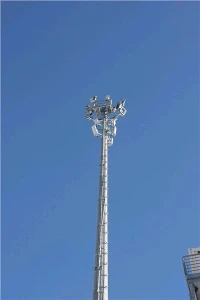

Radio poles, also known as radio towers, play a crucial role in modern communication systems. As a radio pole supplier, I have witnessed firsthand the importance of these structures in supporting different frequency bands. In this blog post, I will explore how radio poles support various frequency bands and the factors that influence their performance.


Understanding Frequency Bands
Before delving into how radio poles support different frequency bands, it's essential to understand what frequency bands are. Frequency bands are specific ranges of electromagnetic frequencies used for different types of communication. For example, the AM radio band operates in the medium frequency (MF) range, typically from 535 to 1705 kHz, while FM radio operates in the very high frequency (VHF) range, from 88 to 108 MHz. Mobile phones, on the other hand, use a variety of frequency bands, including the ultra - high frequency (UHF) and microwave frequency ranges.
Physical Design and Frequency Support
The physical design of a radio pole is one of the key factors in its ability to support different frequency bands. The height of the pole is a critical consideration. Higher poles are generally better for supporting lower frequency bands. This is because lower frequencies have longer wavelengths, and a taller pole allows for better propagation of these longer - wavelength signals. For example, AM radio signals, which have relatively long wavelengths, often require tall radio poles to achieve good coverage.
The shape and structure of the pole also matter. Lattice towers, such as the 5g Wireless Outdoor Tv Cell Phone Communication Satellite Microwave Radio Antenna Lattice Tower 3 Leg Angular Tower, are commonly used for radio poles. Their open - lattice design allows for better airflow and reduces wind resistance, which is important for the stability of the pole. Additionally, the lattice structure can be designed to support multiple antennas, each tuned to different frequency bands.
Antenna Placement and Tuning
Antennas are the key components that enable radio poles to support different frequency bands. Antennas are designed to resonate at specific frequencies, and they can be tuned to match the desired frequency band. When placing antennas on a radio pole, it's important to consider the spacing between them. Antennas operating on different frequency bands should be placed at an appropriate distance to avoid interference.
For example, if a radio pole is supporting both an FM radio antenna and a mobile phone antenna, the two antennas should be placed far enough apart to prevent signal interference. This is because different frequency bands have different propagation characteristics, and close - proximity antennas can cause cross - talk and signal degradation.
Electrical Characteristics and Frequency Adaptability
The electrical characteristics of the radio pole and its associated components also play a significant role in supporting different frequency bands. The impedance of the antenna and the transmission line must be matched to the frequency band of operation. A mismatch in impedance can lead to signal reflection and loss, reducing the efficiency of the communication system.
Modern radio poles are often equipped with advanced electrical components, such as filters and amplifiers. Filters are used to select specific frequency bands and reject unwanted frequencies. Amplifiers, on the other hand, are used to boost the signal strength, especially for long - distance communication.
Environmental Factors
Environmental factors can also affect the ability of radio poles to support different frequency bands. Weather conditions, such as rain, snow, and high winds, can impact the performance of the antennas and the overall stability of the pole. For example, heavy rain can cause signal attenuation, especially at higher frequencies.
The geographical location of the radio pole is also important. In mountainous areas, the terrain can cause signal reflections and multipath interference, which can affect the quality of the communication. Radio poles in urban areas may face challenges due to the presence of buildings and other structures that can block or reflect signals.
Customization for Different Frequency Bands
As a radio pole supplier, we understand the importance of customization. Different customers have different requirements for frequency bands, depending on their specific communication needs. We offer Wholesale Price Customizable Point To Point Phone Tower and Self Standing Communication Tower that can be tailored to support a wide range of frequency bands.
Our engineering team works closely with customers to design radio poles that meet their specific frequency requirements. We consider factors such as the height of the pole, the type of antennas to be used, and the electrical characteristics of the system. By customizing the radio poles, we can ensure optimal performance for different frequency bands.
The Future of Radio Poles and Frequency Band Support
As technology continues to evolve, the demand for radio poles that can support a wider range of frequency bands will only increase. The emergence of 5G technology, for example, requires radio poles that can support higher frequencies in the millimeter - wave range. These higher frequencies offer faster data transfer speeds but have shorter propagation distances, which means that more radio poles will be needed to provide comprehensive coverage.
In the future, we can expect to see more advanced designs of radio poles that are better optimized for different frequency bands. This may include the use of new materials, such as carbon fiber, which can reduce the weight of the pole while maintaining its strength. Additionally, smart technologies, such as sensors and remote monitoring systems, will be integrated into radio poles to improve their performance and reliability.
Conclusion
In conclusion, radio poles are essential for supporting different frequency bands in modern communication systems. Their physical design, antenna placement, electrical characteristics, and environmental adaptability all play crucial roles in their ability to support a wide range of frequencies. As a radio pole supplier, we are committed to providing high - quality, customizable solutions that meet the diverse needs of our customers.
If you are interested in purchasing radio poles for your communication needs, we invite you to contact us for a detailed discussion. Our team of experts is ready to assist you in selecting the right radio pole and designing a system that supports your specific frequency bands.
References
- Johnson, R. C., & Jasik, H. (Eds.). (1984). Antenna engineering handbook. McGraw - Hill.
- Balanis, C. A. (2016). Antenna theory: Analysis and design. Wiley.
- Stutzman, W. L., & Thiele, G. A. (2012). Antenna theory and design. Wiley.